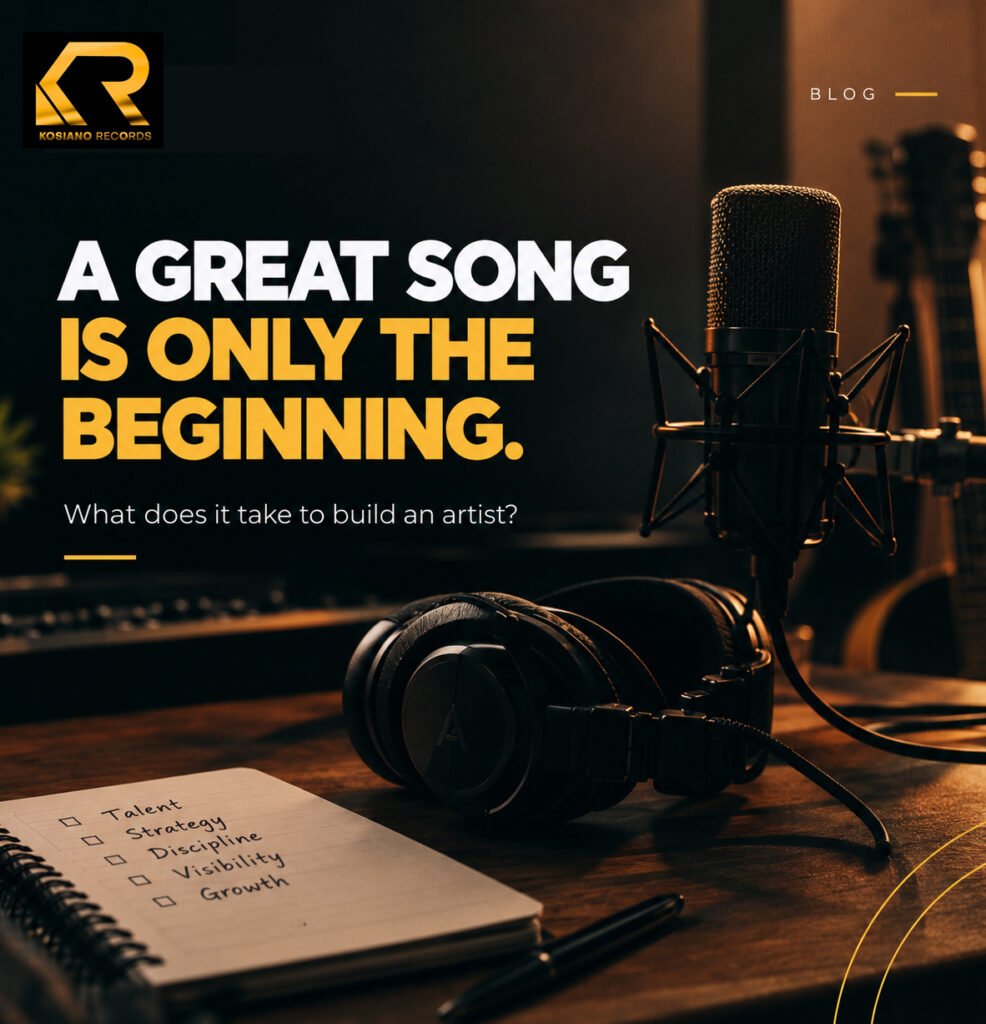
A great song can open the door. But what happens after people hear it?
There is a common belief in music that if an artist makes a great enough song, everything else will somehow fall into place.
- The song will go viral.
- People will discover the artist.
- Streaming numbers will grow.
- Fans will arrive.
- Opportunities will follow.
Sometimes, something close to that happens.
But most of the time, it doesn’t.
The reality of today’s music industry is that a good song is only the beginning.
An artist can have an incredible voice, a beautifully written song and excellent production, yet still struggle to build an audience. Not necessarily because the music isn’t good, but because there is much more involved in turning a song into a career.
Music has to be discovered.
The artist has to be understood.
The audience has to have a reason to care.
And the systems behind the music have to be properly managed.
In an industry where millions of songs are released every year, artists need more than music. They need identity, strategy, consistency, visibility and a connection with their audience.
1. A Good Song Needs an Identity
Before people become fans of an artist, they need to know who that artist is.
What does the artist represent?
What kind of music do they make?
What makes their story interesting?
What do they want people to feel when they experience their music?
This is where artist identity becomes important.
Identity is more than a logo, a hairstyle or a particular colour palette. It is the combination of an artist’s sound, personality, story, values, appearance and creative direction.
Think about the difference between hearing a song and knowing the person behind it.
A song may make someone say:
“This is a great song.”
But a strong artist identity can make them say:
“I want to hear more from this artist.”
That distinction matters.
2. Great Music Needs a Story
People don’t only connect with songs.
They connect with stories.
Why was the song written?
What inspired it?
What was happening in the artist’s life?
What does a particular lyric mean?
What does the song represent?
These questions give an audience something to connect with beyond the audio itself.
A song about gratitude, for example, becomes more meaningful when listeners understand the experience, belief or story that inspired it.
The story doesn’t have to be complicated.
Sometimes the simplest stories are the most powerful.
The important thing is that there is something real for people to connect with.
3. Visibility Matters
A great song cannot connect with an audience if nobody knows it exists.
This sounds obvious, but it is one of the biggest challenges facing emerging artists.
Releasing a song is not the same thing as promoting a song.
Uploading music to streaming platforms is an important step, but it doesn’t automatically create an audience.
Artists have to create opportunities for people to discover their music.
That can happen through:
- Social media
- Short-form video
- Music videos
- Performances
- Interviews
- Collaborations
- Playlists
- Blogs and publications
- Radio
- Influencer and creator partnerships
- Community engagement
- Live events
The goal isn’t simply to tell people “My song is out.”
The goal is to give people multiple reasons and opportunities to discover the song.
4. An Artist Needs a Digital Presence
Today, an artist’s digital presence is often the first place people encounter them.
Someone hears a song and searches for the artist.
What do they find?
Is the artist’s Instagram active?
Does the artist have a professional profile?
Is there a clear visual identity?
Can people easily find their music?
Is the artist’s YouTube channel properly presented?
Are their streaming profiles accurate?
Does the content tell people anything about who they are?
These details matter because an artist’s digital presence becomes part of their public identity.
A great song might get someone to search for you.
Your digital presence can determine what they discover when they arrive.
5. Visuals Are Part of the Music
Music may be heard, but artists are increasingly discovered visually.
Cover artwork.
Music videos.
Photography.
Social media graphics.
Short-form video.
Performance clips.
Behind-the-scenes footage.
Artist branding.
All of these contribute to how audiences perceive an artist.
This doesn’t mean everything has to be expensive.
It means it should be intentional.
A song can have a beautiful visual world around it that strengthens the listener’s understanding of the music.
The visual identity can communicate the mood of a release before someone even presses play.
In an increasingly visual digital environment, that matters.
6. Consistency Builds Recognition
One song can introduce an artist.
Consistency can build an audience.
An artist doesn’t necessarily need to post every day. But disappearing between releases makes it difficult to build a lasting connection with an audience.
There should be something happening between releases:
Music.
Stories.
Personality.
Performances.
Behind-the-scenes moments.
Conversations.
Creative content.
The audience should have opportunities to experience the artist beyond the three or four minutes of a song.
This is especially important because music careers are rarely built around one release.
A single can create attention.
An ongoing body of work and consistent presence can turn that attention into a community.
7. Artists Need to Understand Their Audience
Not everyone who hears a song will become a fan.
And that’s okay.
The important question is:
Who is the music actually for?
Understanding an audience helps an artist make better decisions about content, communication and promotion.
For example, an artist may discover that their audience responds particularly well to:
- Live performances
- Emotional storytelling
- Behind-the-scenes content
- Short music clips
- Inspirational messages
- Dance or performance videos
- Educational content
Data can help reveal these patterns.
Social media analytics, streaming statistics and audience behaviour can tell artists what people are responding to.
The purpose isn’t to become obsessed with numbers.
It’s to understand the people behind the numbers.
8. Distribution and Catalogue Management Matter
There is also a side of the music business that audiences rarely see.
The song needs to reach the platforms correctly.
Metadata needs to be accurate.
Artist profiles need to be properly connected.
ISRCs need to be managed.
Release information needs to be organized.
Royalties need to be tracked.
Ownership and rights need to be documented.
Multiple versions of a release need to be monitored.
A song can be creatively brilliant and still have administrative problems behind it.
That is why artists and labels need proper digital music distribution and catalogue management.
The creative side of music may get the attention, but the administrative side helps protect and manage the value of the work.
9. Artists Need to Think Beyond Streaming
Streaming is important, but an artist’s career can involve much more than streams.
There are opportunities in:
- Live performances
- Events
- Brand partnerships
- Synchronization
- Merchandise
- Collaborations
- Publishing
- Licensing
- Digital content
- Sponsorships
- Fan communities
A song can be the starting point for many different opportunities.
This is why artists should think about their music not only as something they release, but also as an intellectual property asset and part of a larger creative brand.
10. Community Is More Valuable Than Attention
There is a difference between getting attention and building an audience.
Someone can watch a video and scroll away.
Someone else can discover the artist, follow them, listen to every release, attend their shows, share their music and tell their friends about them.
The second relationship is much deeper.
Artists should therefore think beyond:
“How many people saw this?”
And also ask:
“How many people connected with this?”
A strong community gives an artist something that algorithms cannot guarantee.
People who care about the music become part of the journey.
11. The Artist Still Has to Be the Artist
With all this talk about branding, strategy, social media and marketing, there is one important thing to remember:
The music still matters.
Strategy cannot permanently replace substance.
An artist can have beautiful graphics, an excellent social media presence and a strong marketing campaign, but if there is no meaningful artistic foundation, it becomes difficult to build something lasting.
The goal isn’t to distract from the music.
The goal is to help the music reach the people who need to hear it.
Artist development should therefore bring together both sides:
Great music + great presentation.
Creativity + strategy.
Authenticity + professionalism.
Art + business.
The Song Is the Beginning, Not the Entire Journey
A great song is still incredibly important.
It can change someone’s mood.
Tell a story.
Create a memory.
Introduce a new artist.
Open a door.
Start a movement.
But the song is only one part of the journey.
Behind it is an artist with a story.
Around it is a visual identity.
In front of it is an audience.
Behind the scenes are distribution, rights, royalties and business decisions.
And beyond the release is the long-term work of building a career.
The modern artist therefore has to think bigger than the next release.
Don’t just ask, “How do I make a great song?”
Ask:
Who am I as an artist?
Who am I making music for?
How will they discover me?
What will make them stay?
What story am I telling?
How do I turn one listener into a community?
Because a good song can get someone to press play.
But a great artist gives them a reason to press play again.
At Kosiano Records
At Kosiano Records, we believe artists deserve more than simply having their music released.
Music deserves the right strategy, presentation, distribution, audience development and digital management to give it the opportunity to reach the people it was created for.
The goal isn’t simply to release music.
It is to help build artists, stories and lasting musical identities.
