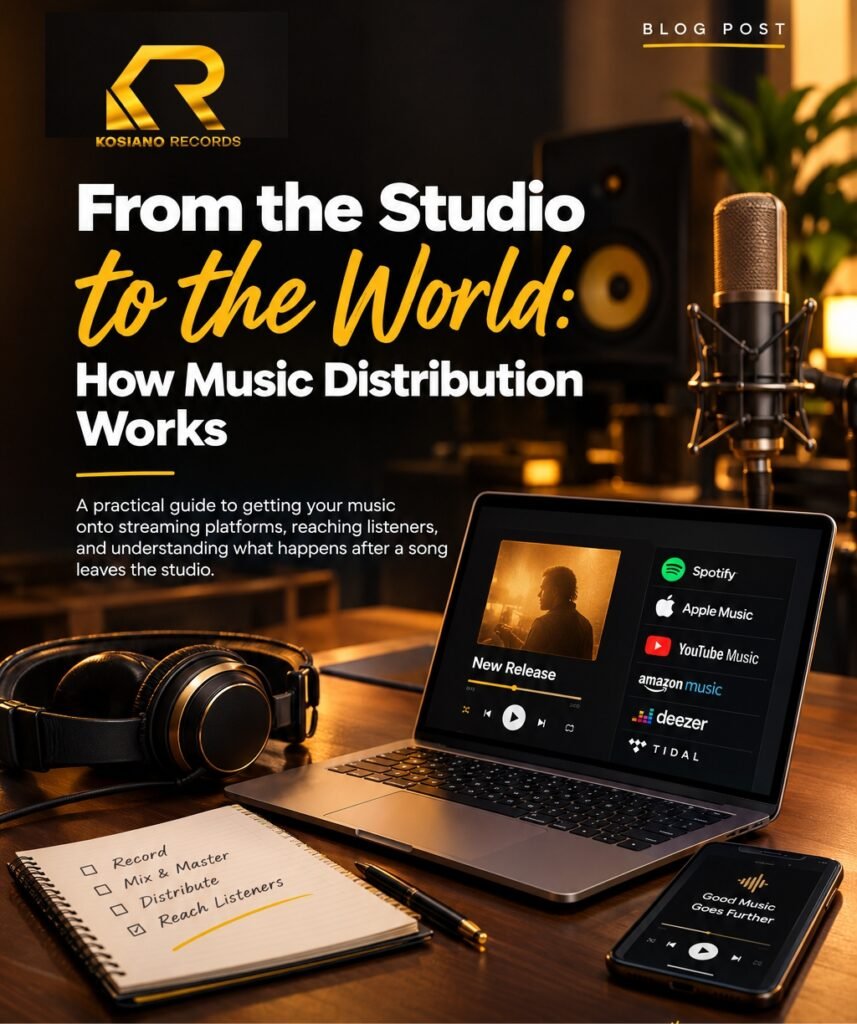
A practical guide to getting your music onto streaming platforms, reaching listeners, and understanding what happens after a song leaves the studio.
A song can begin with a melody in someone’s head, a few lines written in a notebook, or an idea that comes alive during a studio session. After hours of writing, recording, production, mixing, and mastering, the music may finally be ready for the world to hear.
But finishing a song is only one part of the journey.
How does that recording get onto Spotify, Apple Music, Boomplay, Audiomack, YouTube Music, and other digital platforms? Who delivers the music? What information must an artist provide? And how does a release become available to listeners in different parts of the world?
The process behind these questions is called music distribution.
For independent artists, understanding distribution is an important step towards building a sustainable music career. It helps artists prepare releases properly, avoid preventable mistakes, maintain accurate catalogue records, and understand how their music reaches audiences.
Let’s explore how it works.
1. What Is Music Distribution?
Music distribution is the process of delivering a recording to platforms and services where people can listen to, watch, purchase, or otherwise access music.
In the past, distribution was strongly associated with physical formats such as vinyl records, cassette tapes, and CDs. Record labels and distributors helped move those products from manufacturing facilities to shops and, eventually, to listeners.
Today, digital distribution plays a major role in the music industry.
A digital music distributor acts as an intermediary between an artist or record label and participating music platforms. Depending on the distributor and the services it offers, it can deliver audio files, cover artwork, release information, and other required metadata to digital service providers.
These services may include streaming platforms, download stores, and certain video or social music services.
Once a release has been accepted and made available, listeners can access it through the relevant platforms in supported territories.
However, distribution is not the same as promotion. Getting a song onto a streaming platform makes it available; it does not automatically guarantee that people will discover it, add it to playlists, or listen to it.
That is why distribution should be part of a wider release strategy.
2. The Journey Begins Before the Upload
Before a song is delivered to a distributor, the artist or label should make sure the release is ready.
This involves more than exporting an audio file from the studio.
The final recording
The song should be properly mixed and mastered for release. The final audio must meet the distributor’s technical requirements, which may vary depending on the service and delivery format.
Artists should also confirm that the correct version is being submitted. An explicit version, clean version, instrumental, remix, and radio edit may require distinct release planning and accurate labelling.
Cover artwork
A release generally needs artwork that meets the distributor’s specifications. Requirements can include dimensions, file format, image quality, and restrictions on promotional text or logos.
The artwork should represent the release professionally and comply with the platform’s rules.
Release information
The artist or label must prepare the information that identifies and describes the release. This commonly includes:
- Artist name and any featured artists
- Song title and version information, where applicable
- Release date
- Genre and language, where requested
- Songwriter and composer credits
- Label and copyright information
- Explicit-content status
- Relevant recording and release identifiers
Accurate information matters. A spelling error, inconsistent artist name, or incorrect credit can create confusion across platforms and may require a correction after release.
The more carefully a release is prepared, the fewer avoidable problems are likely to arise during delivery.
3. What is a Digital Music Distributor?
A digital music distributor helps deliver music from the artist or label to digital platforms.
Some distributors primarily serve independent artists through self-service dashboards. Others offer label services, catalogue management, reporting, rights administration, or additional support depending on the agreement.
The exact arrangement varies. Some charge subscription fees, some deduct a percentage of earnings, and others use different pricing or service models.
When choosing a distributor, artists should look beyond the promise of getting music online.
Consider the following:
Platform coverage: Which streaming services and territories does the distributor support?
Pricing and deductions: Are there upfront fees, annual charges, commissions, or additional service costs?
Royalty reporting: How clearly can you review earnings, statements, adjustments, and payment history?
Release management: Can you schedule releases, update metadata, and manage multiple artists or a larger catalogue?
Customer support: What happens if a release is delayed, delivered incorrectly, or assigned to the wrong artist profile?
Rights and account access: Who controls the distribution account, and what happens to the catalogue if the agreement ends?
These questions are especially important for record labels managing music for more than one artist.
A distributor is not simply a button that sends music to streaming platforms. It is part of the infrastructure that supports the release and administration of a catalogue.
4. How Does a Song Get onto Streaming Platforms?
Although individual distributors have different systems, the process generally follows a similar sequence.
Step 1: Create the release
The artist or label prepares the final audio, artwork, credits, release date, and other required information.
Step 2: Submit it through the distributor
The release is uploaded through the distributor’s system. The user selects supported platforms and territories, where these options are available, and submits the required details.
Step 3: Review and delivery
The distributor processes the submission and delivers it to the selected platforms. A release may undergo technical, metadata, rights, or policy checks.
If something is incomplete or does not meet the applicable requirements, the release may need correction before it can proceed.
Step 4: Platform processing
Each platform processes the delivery according to its own systems and policies. Timelines can differ, so a release may not become available everywhere at exactly the same moment.
This is one reason artists should submit music well ahead of the intended release date, especially when planning a coordinated campaign.
Step 5: Confirm availability
After the release date, the artist or label should check that the music is live and correctly presented.
Confirm that the song appears under the intended artist profile, the title and artwork are correct, the credits are accurate, and the links lead to the right release.
If a problem appears, contact the distributor with the relevant release details rather than immediately uploading another copy.
The release process is not complete simply because an upload was submitted. Verification is part of release management.
5. Understanding ISRCs, UPCs, and Release Metadata
Music distribution involves identifiers that help distinguish recordings and releases. Two common identifiers are the ISRC and UPC or EAN.
What is an ISRC?
An International Standard Recording Code (ISRC) identifies a particular sound recording or music video recording.
It helps distinguish one recording from another in industry systems. If a song is distributed to multiple platforms, its recording identifier is an important part of maintaining consistent records.
Different versions of a song may need separate identifiers, depending on how the recordings differ and the applicable rules.
What is a UPC or EAN?
A UPC or EAN is generally used to identify a release or product, such as a single, EP, or album, within distribution and retail systems.
Think of it this way: an ISRC identifies a particular recording, while a UPC or EAN identifies the release package.
Why does this matter?
These identifiers can help artists and labels manage their catalogues, investigate delivery problems, compare distributor records, and keep track of releases over time.
They are particularly useful when transferring a catalogue between distributors or investigating why the same recording appears more than once on a streaming platform.
Artists and labels should keep a record of their identifiers and avoid creating unnecessary duplicate releases in an attempt to fix a delivery problem.
6. Choosing a Release Date and Planning Ahead
A release date is not just a detail entered into a distributor’s dashboard. It is a planning decision that affects the entire campaign.
Artists need time to prepare artwork, check credits, submit the release, confirm delivery, create promotional content, and communicate with their audience.
Submitting at the last minute can reduce the time available to correct mistakes or resolve delays.
A practical release timeline might include:
Several weeks before release: Finalise the recording, artwork, metadata, distribution plan, and promotional direction. Submit the release early enough to accommodate the distributor’s and platforms’ requirements.
Before release day: Prepare teasers, short-form videos, artist announcements, pre-save links where available, and other campaign materials.
On release day: Confirm availability, publish the announcement, share correct links, and direct listeners to the music.
After release: Continue promoting the song through performances, behind-the-scenes content, lyric highlights, audience conversations, and other relevant formats.
The exact timeline will depend on the distributor, the release, and the campaign. The important thing is to leave enough time for preparation and verification.
7. What Happens After the Music Goes Live?
Once a song is available, the work continues.
The artist and label should monitor the release, communicate with listeners, and review the information provided by their distributor and streaming platforms.
This includes checking for incorrect credits, profile problems, unexpected duplicates, missing platform availability, and other issues that may affect the release.
It also means looking at performance data.
Depending on the platform and the distributor’s reporting tools, artists may be able to review streams, listeners, audience locations, playlist activity, and earnings. Different services provide different metrics, and the information may not update immediately.
Use the available data to understand what is happening.
Are people finding the song through short-form videos? Are listeners returning to the artist’s catalogue? Are certain territories showing growing interest? Which promotional activities appear to be helping?
These insights can guide future decisions, but they should be interpreted carefully. A spike in views does not necessarily translate into the same increase in streams or revenue.
Distribution makes the release accessible. Monitoring helps the artist or label understand and manage what happens next.
8. How Do Artists Earn Money from Digital Distribution?
Digital music revenue can come from different sources, and it is important to understand what each one represents.
Recording revenue
Streaming services and other digital platforms operate under their own commercial arrangements. Money attributable to a recording may be paid through a distributor or another relevant rights arrangement, depending on the platform and the agreements in place.
The amount an artist receives is not necessarily a fixed rate for every stream. Earnings can vary based on factors such as platform, territory, subscription model, revenue pool, and the applicable contractual terms.
The distributor may also charge fees or retain an agreed share.
Songwriting and publishing royalties
The musical composition is distinct from the sound recording.
Songwriters, composers, and publishers may be entitled to royalties associated with the use of the composition, depending on the type of use, territory, ownership, registrations, and applicable agreements.
These royalties are not always collected through the same channel as recording revenue. Artists should understand which rights they control and which organisations or administrators, if any, manage them.
Other potential revenue streams
Depending on the recording, rights ownership, eligibility, territory, and relevant agreements, other income opportunities may include video monetisation, certain digital performance royalties, licensing, and other authorised uses of the music.
These systems have different rules. For example, royalties associated with certain non-interactive digital radio services are not the same as ordinary on-demand streaming revenue.
Being available on a streaming platform does not mean every possible royalty is automatically registered, collected, or paid to the correct person.
Artists and labels should maintain clear ownership records, understand their agreements, review statements, and investigate any unexplained discrepancies.
9. Common Music Distribution Mistakes to Avoid
A few preventable mistakes can make release management more complicated than it needs to be.
Uploading without checking the details
Incorrect titles, credits, artist names, artwork, and release information can create problems that take time to correct.
Waiting until the last minute
Late submissions can leave little time to fix delivery issues or prepare an effective campaign.
Assuming distribution guarantees promotion
A song can be available worldwide without receiving meaningful attention. Artists still need to build awareness, create content, connect with listeners, and pursue suitable promotional opportunities.
Ignoring the catalogue after release
Keep copies of release details, identifiers, agreements, and reports. These records become increasingly important as the catalogue grows.
Re-uploading a song to solve every problem
Uploading the same recording again may create duplicate listings or split listeners and reporting across multiple entries. Investigate the existing release and contact the responsible distributor before creating a replacement.
Overlooking rights and royalty administration
Confirm who owns the master recording, who wrote the composition, what the agreements say, and which parties are responsible for distribution and royalty collection.
Losing control of account access
Labels should know which account manages each release, who has permission to make changes, and how catalogue information can be retrieved if a working relationship ends.
Good distribution practice is about more than getting a song online. It is about keeping the release accurate, traceable, and manageable over time.
10. What Should Independent Artists and Record Labels Do Differently?
Artists and labels share many distribution responsibilities, but their priorities may differ.
An independent artist managing a small catalogue may focus on choosing a suitable distributor, preparing releases correctly, understanding their agreement, and tracking their own earnings.
A record label may need a more structured system.
For every release, the label should maintain a catalogue record containing the song title, artist, release date, ISRC, UPC or EAN, distributor, master ownership, songwriting information, royalty arrangements, platform links, and relevant account or reference details.
The label should also document release status, promotional plans, reporting periods, and unresolved issues.
As more artists and recordings are added, relying on memory or scattered messages becomes risky. A central catalogue record helps the label understand what it owns or administers, where each release is delivered, and how to follow up on problems.
For a label like Kosiano Records, distribution is one part of a connected digital operation. Artist development, social media, website content, release promotion, rights administration, and revenue monitoring all contribute to how music is managed from the studio to the listener.
Final Thoughts: Distribution Opens the Door
A finished song deserves a clear path to its audience.
Digital music distribution helps artists and record labels deliver their work to streaming platforms and other music services, but the process requires preparation, accurate metadata, careful release planning, and ongoing management.
Artists should understand the role of their distributor, keep reliable catalogue records, check releases after delivery, and learn how recording revenue differs from songwriting and other rights-related income.
Most importantly, they should remember that distribution and promotion work together. Making a song available creates an opportunity. Building awareness and connecting with listeners help that opportunity grow.
The journey doesn’t end when the recording leaves the studio.
That is where its journey to the world begins.
Discover Music from Kosiano Records
Kosiano Records is committed to supporting music through thoughtful release management, digital presence, and intentional promotion.
Discover Winny Uche, Kosiano Records’ Gospel artist, and experience her release “Ojichukwu Chants,” a song centred on praise, gratitude, and trust in God.
Explore the artist and listen to the song through Kosiano Records’ official website and social channels. You can also watch the official music video through the label’s YouTube channel.
